The Dawn of Agentic AI: Nvidia's Vision for Autonomous Reasoning
What if AI could think, reason, and act autonomously—just like humans? At GTC 2025, Nvidia unveiled technologies that bring us closer to this reality. Agentic AI, a concept that emphasizes machines capable of autonomous reasoning and decision-making, took center stage with some groundbreaking innovations.
One of the most anticipated announcements was Blackwell Ultra, a platform set to redefine performance for reasoning AI workloads. Promising a staggering 40x improvement over the previous Hopper architecture, Blackwell Ultra is tailored for tasks that demand advanced inference capabilities during both training and test-time scaling. This leap in processing power could enable AI systems to analyze complex scenarios and act independently in real-time.
Complementing this was the reveal of Vera Rubin, Nvidia’s next-generation GPU architecture, expected in H2 2026. Vera Rubin features NVL 144 systems with entirely redesigned components, ensuring robust support for agentic AI applications. From powering intelligent assistants to autonomous decision-makers, this architecture is designed to handle the computational demands of reasoning-based AI.
Perhaps the most intriguing development was the introduction of Llama Nemotron, Nvidia’s open model family designed for reasoning AI. These models lay the groundwork for building sophisticated AI agents that can think and act autonomously, pushing the boundaries of human-like intelligence in machines. Nvidia's focus on agentic AI signals a future where machines are not just tools but collaborators capable of real-world reasoning. Learn more from Nvidia GTC 2025 Updates.
Physics AI and Quantum Computing: Redefining the Boundaries of Innovation
Can AI predict the laws of physics and unlock quantum realms? Nvidia’s GTC 2025 showcased several innovations aimed at redefining how we interact with the physical world and the quantum frontier.
The Newton Physics Engine, developed in collaboration with Google DeepMind and Disney Research, is one of Nvidia’s most groundbreaking contributions to Physics AI. Designed to optimize robot learning, this open-source engine seamlessly integrates with simulation frameworks like Google’s MuJoCo and Nvidia’s own Isaac Lab. It equips robots with the ability to understand and simulate real-world physics, making training faster and more accurate. By bridging the gap between virtual simulations and real-world applications, Newton paves the way for smarter autonomous systems.
Another highlight was the Cosmos World Foundation Models (WFMs). These models allow developers to create AI-driven synthetic worlds that mimic real-world interactions. For robotics and autonomous vehicles, Cosmos transforms structured video data into realistic scenarios, helping machines anticipate and adapt to complex environments. This leap forward in simulation technology could save time and resources while delivering more reliable AI systems.
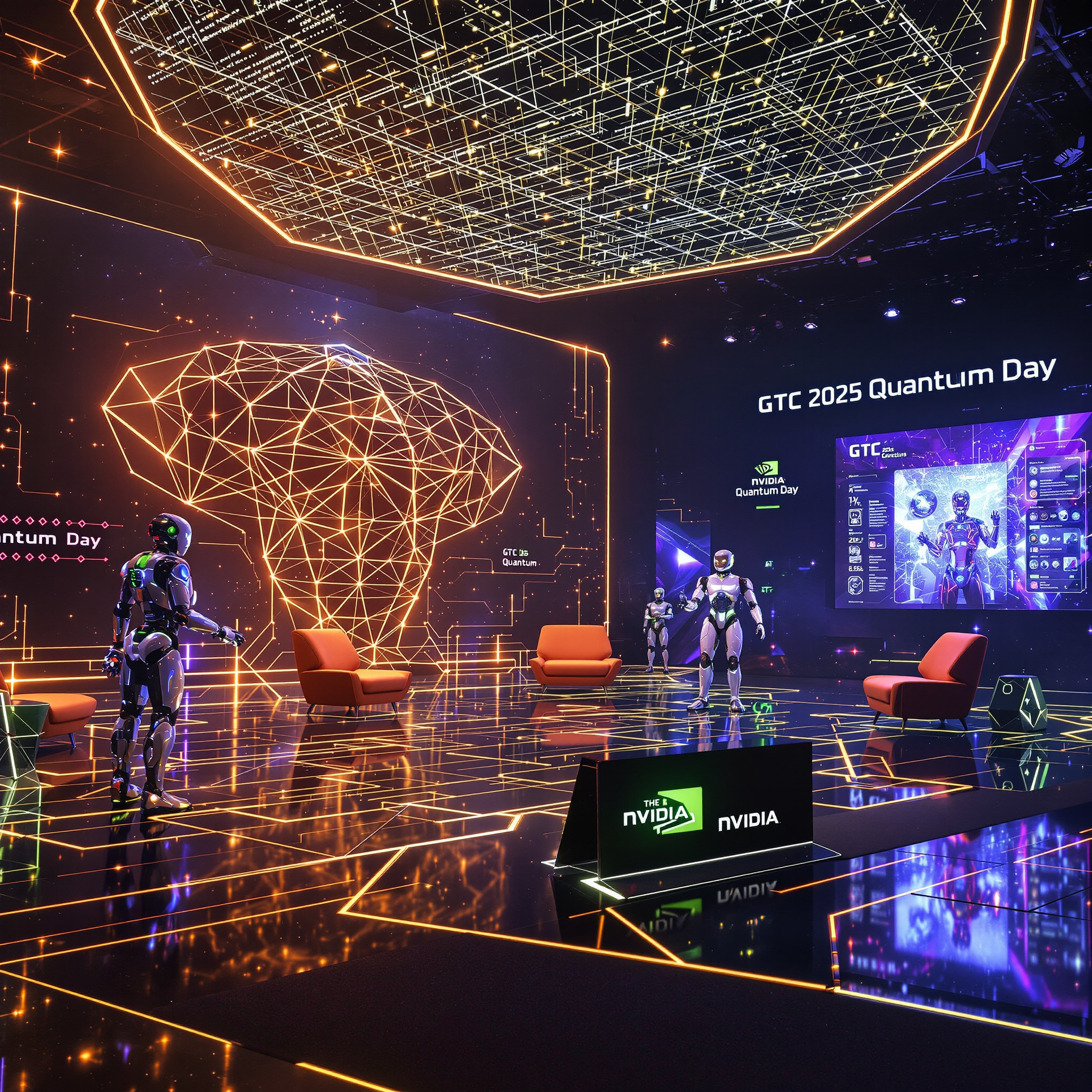
On Quantum Day, Nvidia revealed initiatives that could revolutionize computing as we know it. The introduction of Spectrum-X and Quantum-X photonics networking platforms promises unparalleled bandwidth—1.6 Tb/s per port and up to 400 Tb/s in aggregate. This capability supports high-speed communication across massive GPU clusters, enabling millions of GPUs to work cohesively in quantum computing tasks. These platforms underscore Nvidia’s commitment to bridging AI and quantum computing, a partnership that could unlock unprecedented computational power. Dive deeper into Nvidia's quantum computing advancements.
The Rise of Intelligent Machines: From Healthcare to Humanoid Robotics
Imagine robots performing surgeries or filling labor gaps with human-like reasoning. Nvidia’s GTC 2025 introduced technologies that bring these scenarios closer to reality, with innovations in healthcare and humanoid robotics leading the charge.
The Isaac GR00T N1 stands out as a revolutionary foundation model for humanoid reasoning and skills. Built to address labor shortages across industries, this model features a dual-system architecture inspired by human cognition. System 1 operates reactively, handling immediate situations, while System 2 processes information analytically before executing actions. This design enables robots to perform tasks requiring both speed and thoughtfulness—qualities essential for industries like manufacturing, logistics, and even education.
In healthcare, Nvidia’s partnership with GE HealthCare led to the creation of Isaac for Healthcare, an AI-driven simulation platform for medical robots. By using realistic models of human anatomy and medical environments, this platform trains robots for tasks like surgery and diagnostic imaging. For regions facing doctor shortages, Isaac for Healthcare could revolutionize accessibility and precision in medical care. It’s a step toward a future where AI-powered robots become indispensable partners in healthcare. Explore Nvidia’s healthcare initiatives.
These advancements demonstrate Nvidia's determination to lead the charge in intelligent machines. From humanoid robots to medical assistants, the rise of intelligent machines signals a future where technology works hand-in-hand with humanity to solve critical challenges.